
Corruption vs Crimson vs Hallow: World Evil Guide (1.4.5)
Corruption or Crimson — which world evil to pick, what each biome contains, how spread works pre- and post-Hardmode, and how to quarantine your world.
FAQ
Should I choose Corruption or Crimson in Terraria?
Can a world have both Corruption and Crimson?
Does the Hallow count as an evil biome?
How do I stop Corruption or Crimson from spreading?
When does biome spread slow down?
What are the world evils?
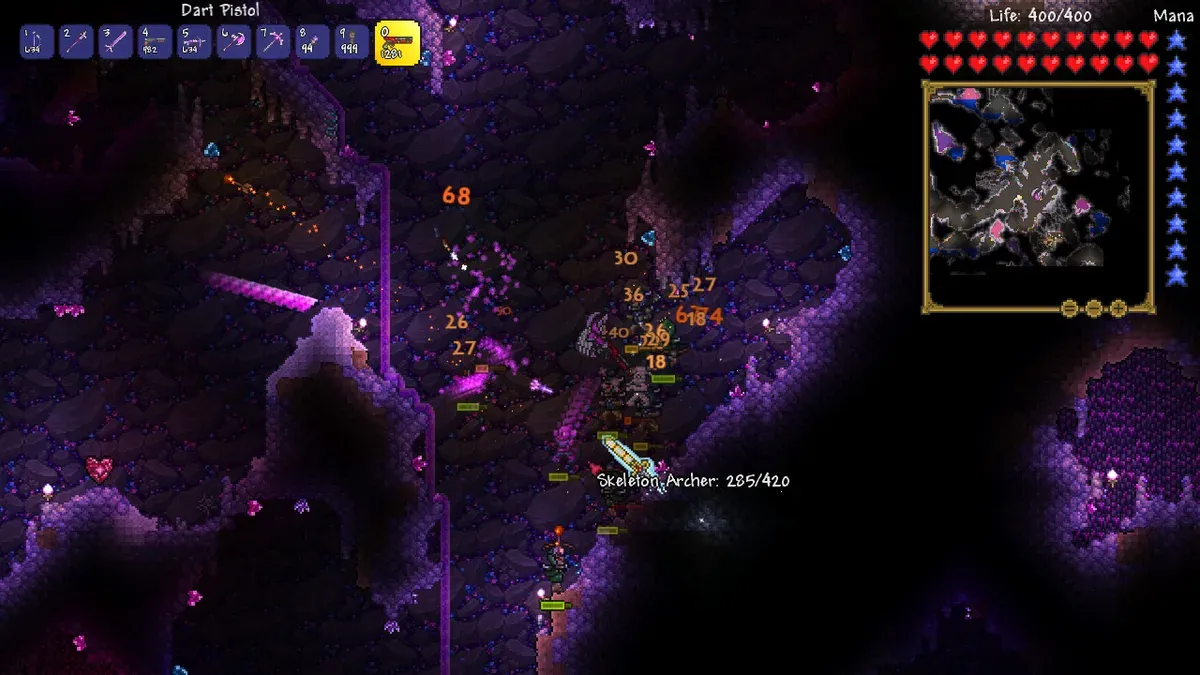
Every Terraria world generates with exactly one evil biome, chosen at world creation (or left to a coin flip): the purple, rotting Corruption or the red, fleshy Crimson. A third spreading biome — the pastel, deceptively cute Hallow — does not exist at worldgen; it detonates into the world the moment the Wall of Flesh dies and Hardmode begins.
A biome officially counts once roughly 300 evil tiles (grass, stone, sand, ice variants) cluster in one area — enough to flip the music, background, water color, enemy table, and fishing loot. Below the surface each evil has an Underground counterpart that spawns its own enemies and drops Souls of Night (evil) or Souls of Light (Hallow) in Hardmode.
Corruption vs Crimson — the actual differences
Both evils do the same job: vertical chasms leading to breakable orbs/hearts, an evil-themed boss, and a regional material tier. The details differ:
| Corruption | Crimson | |
|---|---|---|
| Theme | Rot, decay, purple wasteland | Flesh, gore, living tunnels |
| Chasm loot orb | Shadow Orb | Crimson Heart |
| First orb/heart drop | Musket (gun) | Undertaker (gun) |
| Ore / bars | Demonite / Demonite Bars | Crimtane / Crimtane Bars |
| Regional boss | Eater of Worlds (worm, splits on segment death) | Brain of Cthulhu (phase-2 teleport swarm) |
| Signature debuff | Cursed Inferno (huge DoT, from Cursed Flames/Spitters) | Ichor (defense-reducing, from Ichor Stickers/Golden Shower) |
| Gear flavor | Slightly faster tools and weapons | Slightly higher stats, health-regen armor set |
Smashing an orb or heart is the classic way to force the boss: three broken orbs summon Eater of Worlds / Brain of Cthulhu on the spot, and every smash also has a chance to drop a Meteorite into the world overnight — the reason most players break exactly one, grab the free gun, and walk away until they want the fight.
The boss you get is world-bound: a Corruption world has no Crimson Hearts to break, so the Brain of Cthulhu requires an artificial Crimson or a second world. Special seeds change the rules — the Drunk world generates both evils natively.
The Hallow — Hardmode’s counter-infection
When the Wall of Flesh falls, the game carves two diagonal stripes from sky to Underworld in a giant V: one converts to your world evil, the other to Hallow. Unicorns, Pixies, and Gastropods replace the wildlife; the Underground Hallow grows Crystal Shards (a key mage/ranger crafting material) and spawns Gelatin Crystals, which summon the optional Queen Slime fight.
The Hallow is mechanically an infectious biome like the evils, with one kindness: it never makes NPC housing invalid, so settlers can live inside it happily. Most players let Hallow run free and only quarantine the evil side. For the full breakdown of what to check the moment your world flips, see our Hardmode transition guide.
How biome spread actually works
The official wiki’s mechanics are worth knowing precisely:
- Range: a corruptible tile converts if an infectious tile sits within 3 tiles (a 7×7 area centered on the target). Thorny bushes and vines that sprout on infected grass can bridge that gap past the edge — this is why bare 3-wide trenches sometimes fail.
- Pre-Hardmode: only grass and thorny bushes convert, and only when directly adjacent. The evil is cosmetic-level slow.
- Hardmode: the same biomes start converting stone, sand, hardened sand, sandstone, and ice — plus jungle grass (mud reverts to plain dirt, permanently deleting Jungle). Surface spread is roughly 6× faster than underground conversions.
- Sunflowers block conversions within 2 tiles of themselves on the surface — a cheap early containment line.
- Post-Plantera: all spread speeds halve.
- Immune tiles: Snow Blocks, Mushroom grass, and Ash grass never convert — which is why mushroom builds are safe and why a Glowing Mushroom farm survives next door to an evil.
- Evil walls: infected background walls can spread to other walls but never convert blocks — safe to ignore.
- Kill an enemy in an evil biome in Hardmode and there’s a 1/2500 chance it drops a Corruption/Crimson Key, which unlocks the matching Biome Chest in the Dungeon post-Plantera.
Containment playbook
- Before the V lands: dig hellevator-style trenches at least 3 tiles wide on both sides of your main evil biomes; line the evil-side wall with incorruptible blocks (wood, any brick, hay) or go 4–6 wide so thorny bushes can’t bridge.
- Protect the Jungle first — it’s the only critical biome that spreads destroys rather than recolors, and Chlorophyte farming matters later.
- Hardmode check: walk the new V stripes and trench the evil stripe near anything you care about (spawn town, jungle, pylon network).
- Mass cleanup: buy the Clentaminator from the Steampunker (post-mechanical-boss) for 2 platinum and spray Green Solution — the screenshot above shows its huge circular radius. Biome-sight potions help find the last stragglers; the Dryad reports your world’s exact corruption percentage.
- Artificial biomes: you can add a missing evil with Corrupt/Crimson Seeds, Unholy/Blood Water, or the matching Clentaminator solution (Steampunker sells them during a Blood Moon, matching your world’s native evil). 300 tiles is all it takes — useful for farming the other boss’s drops or Ichor in a Corruption world.
Which should you pick for a first world?
Pick Crimson if you want a marginally easier ride: its enemies hit slightly harder but its loot (Undertaker, Ichor access, health-regen armor, the Rotted Fork spear) is kinder early. Pick Corruption if you prefer the classic experience — its chasms are easier to navigate than Crimson’s tight spiral fingers, and Cursed Inferno weapons are excellent against worms and Plantera.
Either way, the choice is cosmetic-level. What matters is knowing spread mechanics before the Wall falls — get trenches dug first, and let the Hallow do whatever it wants.
Screenshot sources: cover — official Steam store screenshot (Re-Logic); gallery — wiki.gg world-map renders, screenshots and the Clentaminator radius diagram, used under the official wiki’s media policy.
Gallery
Related Articles
Hardmode Guide: What to Do After the Wall of Flesh (1.4.5)
Hardmode transition checklist — the V-shape biome stripes, Pwnhammer altars and ore tiers, wings, mechanical bosses, Plantera, and how to survive the spike.
Last updated Oct 5
The Dungeon Guide: Skeletron Access, Loot & Post-Plantera (1.4.5)
How to unlock Terraria's Dungeon, what the Dungeon Guardian does below −3 depth, every loot type, and why the walls change everything after Plantera.
Last updated Oct 5
Pylon Guide: All 11 Types, NPC Rules & Network Setup (1.4.5)
All 11 Terraria pylons — the 2-NPC staffing rule, biome requirements, one-per-type limits, the Universal Pylon, and the teleport network.
Last updated Oct 5
Was this helpful?
Thanks for the feedback!